

Description
Pico Laser Hollywood Peel for severe acne, large pores, uneven skin tone, dull skin, and ageing skin that delivers with minimal downtime.
Pico Laser also known as Hollywood Peel the instant laser peel or Carbon Laser Peel is the gold standard treatment for acne sufferers and those with enlarged pores, congestion, uneven skin texture, and uneven skin tone. It is the ideal, sure, and safe way to maintain youthful bright, and firm-looking skin all year round, a true award-winning facial rejuvenation treatment that addresses anti-aging needs and minor to major skin flaws such as congestion and acne. If you have tried microdermabrasion or beauty facials with little to no improvement in your skin, we can assure you our Instant Laser Peel treatment will make a difference.
No matter how well we take care of our skin, sometimes fine lines will appear on our faces. They’re a part of nature, but not all of us like this part of nature. In order to combat the appearance of fine lines, at our center we recommend that our clients get a Hollywood Peel. The laser peel procedure is a safe way to reduce fine lines, and it also helps minimise the look of scars and reduce the size of pores.
A PicoGlow Laser Peel can also be used to combat acne. Acne can follow you far beyond your teenage years, and our PicoGlow Peels can help you with your battle against acne. We actually use two different lasers, Toning and Q-switch. The Tong laser encourages skin regeneration, while the Q-switch laser reveals a new, healthy layer of skin as it unclogs pores.
What is pico laser?
Pico laser delivers energy in pulses measured in picoseconds, that is, trillionths of a second. Because the pulse is shorter than the time heat needs to spread into surrounding tissue, the dominant effect is photoacoustic rather than thermal. Pigment particles are fractured mechanically instead of being heated. The fragments are then cleared by the skin’s immune and lymphatic systems over the weeks that follow.
What can pico laser treat? Pigmentation, melasma and acne marks:
- Freckles, sun spots and age spots lie within the epidermis, which makes them the most predictable pico laser targets, as superficial pigment is reached at lower energy and cleared in fewer sessions. Across clinical trials, pico lasers cleared solar lentigines in 67.9 to 93 per cent of cases, compared with 36 to 77 per cent for Q-switched lasers. In a split-face randomised trial in Asian patients, 85.7 per cent of picosecond-treated sites showed more than 50 per cent improvement at six months, against 57.2 per cent for the Q-switched side, with less treatment discomfort and no difference in side effects. A 532 nm picosecond laser cleared more than 75% of 93% of sun spots in one session in Asian patients, and a randomised trial found 532 nm picosecond and nanosecond lasers equally effective, with higher satisfaction on the picosecond side.
-
Melasma is chronic and relapse-prone, driven by ultraviolet and visible light, heat, hormonal influence, inflammation and impaired barrier function. A 2023 meta-analysis found that low-fluence 1064 nm picosecond laser significantly reduced melasma severity scores without significant side effects, whereas 755 nm picosecond laser was not superior to topical agents and caused post-inflammatory hyperpigmentation. Pico laser is therefore used for melasma at this clinic as one part of a long-term plan with sun protection, trigger control and topical maintenance, not as a cure. Singapore’s year-round ultraviolet exposure and ambient heat make that maintenance layer the harder half of the plan, as pigment suppressed by laser alone recurs once the triggers resume. In a split-face randomised trial, 1064 nm picosecond and nanosecond lasers improved melasma equally, with less pain on the picosecond side.
-
Post-acne dark marks (post-inflammatory hyperpigmentation) responds once the acne driving it is controlled. Inflammation stimulates melanocytes to deposit additional pigment, so treating marks while breakouts continue is counterproductive, as each new lesion generates a fresh deposit faster than the laser clears the old one. Many post-acne marks also fade without any laser over three to twelve months once the inflammation settles, so acne control is addressed first and laser is reserved for pigment that persists beyond that window.
-
Dullness and uneven tone with Low-fluence toning passes across the whole face can improve tone and clarity with little downtime. Each pass fragments a small proportion of the dispersed epidermal pigment and provokes a mild dermal remodelling response, so the change accumulates across a series rather than appearing after one session. The evidence for rejuvenation is graded level II. Results also depend on skincare, sun protection and sleep, as continued ultraviolet exposure and poor recovery generate fresh pigment while the laser is clearing the old.
- Acne skin the pico laser can be used to reduce inflammation and oil production associated with acne. In a 3-step process, first, a lotion is applied to the skin that allows enhancement of the laser. Second, the laser treats the skin, lightly heating the skin cells and stimulating them as well as the hair follicles where acne starts. Lastly, laser treatment is used to create a peel or exfoliation. The lotion is removed during this process, removing with it skin surface cells and unclogging pores. Improvement is often seen after the first treatment, although a series of treatments is recommended for more significant results. Treatments are typically repeated every 2-3 weeks. Once the acne is improved, maintenance treatments may be desired every few months. The carbon peel is virtually painless with no downtime. PicoGlow laser help reduction of pore size and new collagen formation
How it works
Laser energy lightly targets a specialized carbon or graphite-based lotion that is placed on the skin, heating the dermis with every laser pulse emitted. The heat is so instantaneous that no skin damage is observed during the treatment but delivers the right amount of energy to disrupt sebaceous secretion minimizing oil flow, stimulating increased collagen quality, and degrading acne bacteria growth. The laser is then passed over the skin in a different mode to lightly ablate (peel) the top layer of dead skin. The process can also potentially break up the superficial pigment to provide even skin tone, revitalise skin function to maintain a healthy appearance and smoothen skin texture to provide a youthful glow.
Frequently Asked Questions
Treating aging skin is an ongoing commitment but we recommend performing one treatment every second month after you have achieved your initial desired skin complexion outcome. The initial course of treatments as set by your laser clinician will take your skin to the next level of where it needs to be.
With no downtime and minimal side effects or risks, you may immediately return to your daily activities. Discuss all concerns, related history, medication, skincare, aftercare, and specialised instructions with your laser clinician before undertaking this procedure.
The majority of clients report no pain but only experience slight warming of their skin along with a mild tingling sensation as the laser is passed over. Typically, no anesthesia or topical numbing is needed.
Asian skin, typically Fitzpatrick types III to V, carries more baseline melanin and more reactive melanocytes, so heat, irritation or an aggressive setting is more likely to provoke post-inflammatory hyperpigmentation. Conservative settings and an accurate diagnosis are therefore the controlling variables, rather than the choice of laser itself. A meta-analysis of picosecond laser in Asian patients found 56 per cent were rated excellent and a further 29 per cent good for pigment clearance by a dermatologist at least three months after treatment, with similar results across 532, 755 and 1064 nm wavelengths. The most common error is treating every brown patch with the same settings. Freckles, sun spots, melasma, Hori’s naevus, post-acne marks and irritation pigment are difficult to separate on inspection alone yet respond differently to identical energy, and melasma in particular can darken under settings that clear a sun spot. Durable improvement depends further on control of inflammation, restoration of the skin barrier, reduction of ultraviolet and visible light exposure, and maintenance that lowers recurrence.
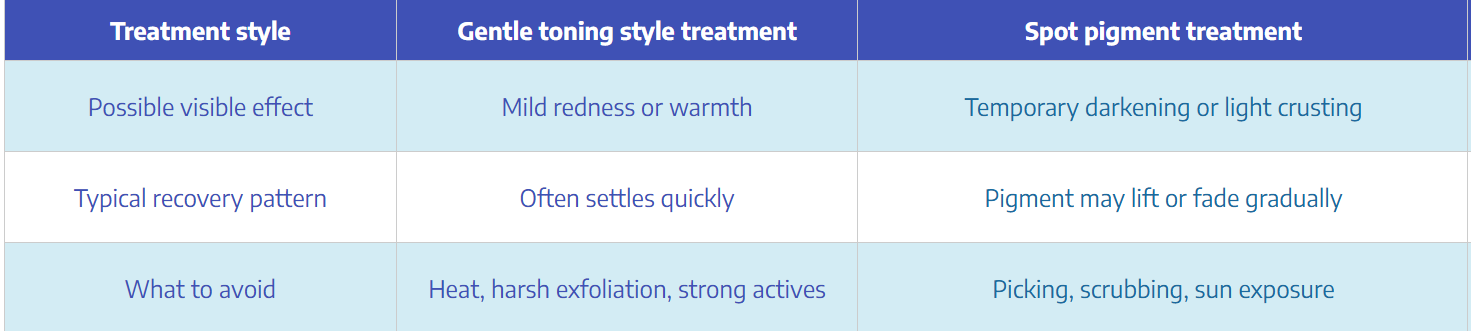
What to expect after Pico laser


Reviews
There are no reviews yet.